
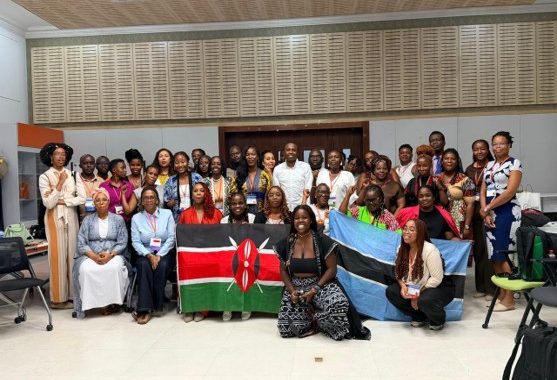
In lecture halls, breakout rooms and informal conversations across Universidad ICESI in Cali, Colombia, participants at the 34th International Association for Feminist Economics (IAFFE) Annual Conference debated one central question: What will it take to build economies that truly work for everyone?
Held under the theme Feminist Economics and Transformative Change: Ideas, Policies and Movements, the conference brought together more than 500 scholars, policymakers, practitioners and activists from around the world to examine how feminist economic thinking can influence public policy, reshape institutions and improve everyday lives. The conference adopted a hybrid format, with virtual sessions held from 26–27 June 2026 followed by in-person sessions from 8–11 July 2026 in Cali. Sessions were conducted in both English and Spanish, reflecting IAFFE’s commitment to making feminist economic scholarship more inclusive and globally accessible.
Featuring paper presentations, roundtable discussions, poster sessions and regional meetings, IAFFE 2026 created opportunities for scholars, policymakers and practitioners to exchange evidence, challenge assumptions and advance new thinking on feminist economic transformation. For WEE-Ghana, it provided an opportunity to contribute evidence from Ghana to international discussions on public spending, taxation and care—three interconnected policy areas that shape women’s economic empowerment and remain central to the project’s research agenda. Led by Co-Principal Investigator Prof. Abena Oduro, the WEE-Ghana delegation, comprising Dr. Godson Aloryito, Dr. Faustina Obeng Adomaa and Dr. Gloria Afful-Mensah, shared research findings, exchanged perspectives with colleagues from across Africa, Latin America, Asia and beyond, and contributed Ghanaian evidence to global conversations on feminist economic transformation.
Reimagining Public Spending for Women’s Economic Empowerment
The first of these conversations centred on public spending and a fundamental question for policymakers: What makes government expenditure genuinely transformative for women?
Addressing this question, Godson Aloryito presented Public Spending as a Driver for Female Empowerment in Ghana: The Case of Three Districts, co-authored with Abena Oduro. Drawing on national expenditure policies and evidence from three districts in Ghana, the study examined how public spending influences women’s economic empowerment and why the outcomes often fall short of policy ambitions. While Ghana has adopted gender-responsive budgeting and demonstrated a strong commitment to gender equality, the research found that national policy intentions frequently become diluted during implementation. Gendered social norms, local political dynamics and persistent underinvestment in gender mainstreaming continue to constrain the transformative potential of public expenditure.
Reflecting on their findings, the authors note, “Public expenditure becomes gender-responsive and empowering for women when the budgeting process, encompassing planning, design, and implementation, actively seeks and prioritizes women’s voices.”
The presentation resonated strongly with wider conference discussions on feminist macroeconomics and gender-responsive budgeting, where participants emphasised that public expenditure alone does not guarantee equitable outcomes. Rather, transformative public spending requires institutions that enable women’s meaningful participation in planning, implementation and accountability. For WEE-Ghana, these discussions reinforced the importance of moving beyond policy commitments towards governance systems that ensure public resources respond to women’s lived realities.
Rethinking Taxation as a Foundation for Gender Equality
If public spending determines how governments invest resources, taxation determines how those resources are mobilised. IAFFE participants therefore turned their attention to an equally important question: How can governments raise revenue in ways that are both equitable and sustainable?
Contributing to this debate, Abena Oduro presented Rethinking Taxation, Fiscal Policy and Gender under Debt Constraints: A Case Study of Ghana, co-authored with Dr. Gloria Afful-Mensah. The paper examined how fiscal pressures and debt constraints are reshaping taxation in Ghana, arguing that efforts to expand domestic revenue must be accompanied by equitable tax policies and transparent public spending if they are to advance women’s economic empowerment. Rather than viewing taxation solely as a revenue-generation exercise, the study positioned it as part of a broader social contract between governments and citizens.
As Abena Oduro observed, “A credible fiscal contract is crucial for establishing public trust and promoting tax compliance.”
The presentation stimulated discussions on the importance of strengthening tax administration, improving the use of sex-disaggregated fiscal data and ensuring that increased public revenues translate into investments that benefit women and marginalised groups. Comparative experiences shared during the conference—including reflections on Colombia’s fiscal reforms—highlighted the importance of linking taxation not only to economic growth but also to equity, accountability and investment in public goods such as care infrastructure.
Recognising Care as Essential Economic Infrastructure
If taxation determines how governments raise resources and public spending determines how those resources are allocated, care raises a more fundamental question: what kinds of work and social investments are recognised as essential to economic development?
Exploring this issue, Faustina Obeng Adomaa presented How State Policies Discipline Households and Communities: Insights from a Review of Ghana’s Care Policies, co-authored with Prof. Dzodzi Tsikata. The paper examined Ghana’s policy landscape through the lens of care, arguing that existing frameworks continue to assign primary responsibility for care to households and communities, with women bearing a disproportionate share of unpaid care work. The study challenged policymakers to reimagine care not as a private family responsibility but as a public good requiring sustained state investment.
At the heart of the paper is a compelling proposition:
“Care policies can foster equitable care systems only when care is seen as a public good for which the state takes a central role in provision.”
The presentation contributed to the conference’s vibrant conversations, where participants explored how recognising, reducing and redistributing unpaid care work is fundamental to achieving women’s economic empowerment. Across diverse country contexts, discussions underscored that investments in care infrastructure are not simply social expenditures—they are economic investments that expand opportunities for women’s participation in education, employment and public life.
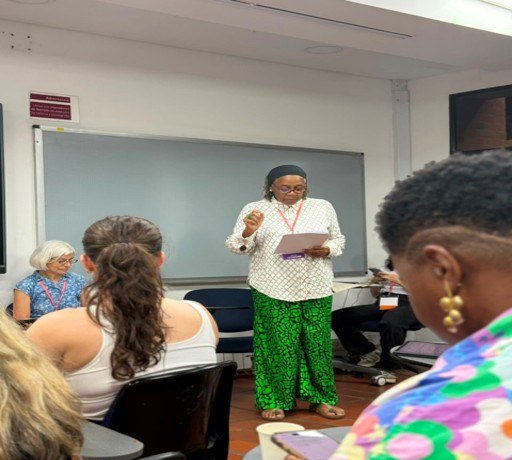
Prof. Abena Oduro presenting her paper at the IAFFE conference in Cali, Colombia
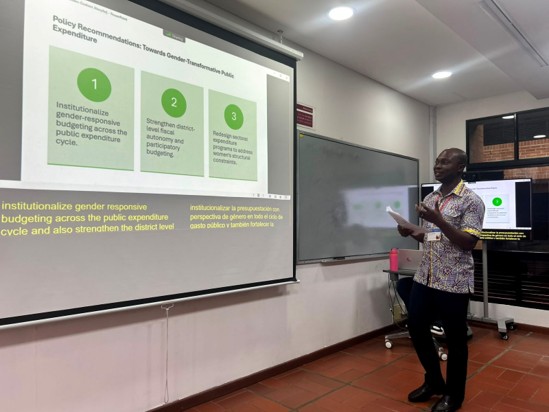
Dr. Godson Aloryito elaborating on public expenditure for women’s economic empowerment
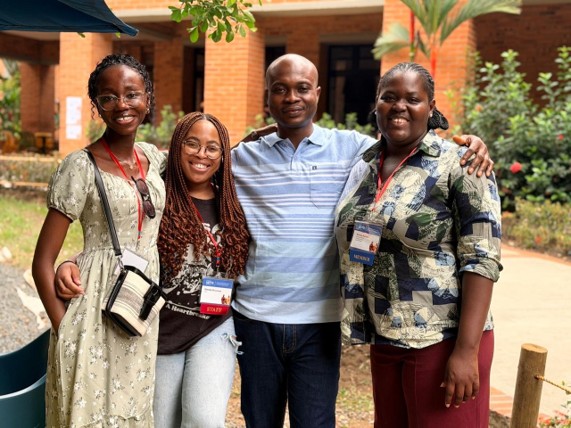
Some conference participants up-close: (From left) Francisca Owusu- Mc-Master University; Wendy Khonziwe -IAFFE; Dr. Godson Aloryito; Eunice Asiedu- GIMPA
Beyond the formal presentations, IAFFE 2026 created numerous opportunities for participants to build professional relationships, strengthen regional networks and exchange experiences in informal settings. Members of the WEE-Ghana team participated in the meeting of IAFFE’s Africa Regional Network Group. Conversations continued over coffee, during networking events and at social gatherings, where scholars, practitioners and activists reflected on shared challenges and emerging opportunities for advancing feminist economic research and policy.
The conference also embraced the cultural vibrancy of its host city. The WEE-Ghana delegation joined fellow participants in celebrating Cali’s world-renowned salsa tradition, stepping onto the dance floor alongside colleagues from across the globe. Amid laughter, cheers and enthusiastic encouragement, such social events provided a light-hearted reminder that meaningful professional relationships are often strengthened as much through shared cultural experiences as through formal academic exchanges. Importantly, it reinforced the fact that IAFFE is more than an academic conference—it is a global community where ideas, partnerships and lasting professional relationships continue to flourish long after the conference ends.
As WEE-Ghana continues to generate evidence on women’s economic empowerment, the insights, partnerships and conversations initiated at IAFFE 2026 provide a strong foundation for continued engagement with the global feminist economics community.
Founded in 1992, IAFFE is an international network of approximately 800 members across more than 90 countries, bringing together economists and scholars from diverse disciplines committed to advancing gender-aware economic research and policy. The annual conference has become one of the foremost global platforms for debating how economic systems, institutions and public policies can better respond to inequalities affecting women and marginalised groups.