
On 18th June 2026, members of the WEE-Ghana project team convened for the third reading session of the year. The discussion was anchored on two articles: Buyana’s (2009) examination of gender-responsive local government budgeting in Uganda and Cabannes and Ming’s (2013) analysis of participatory budgeting in Chengdu, China. Together, the readings prompted a rich conversation on participation, budgeting, local governance and the conditions necessary for meaningful inclusion in development decision-making.
Although the studies emerged from different contexts, participants identified several issues that resonate strongly with ongoing debates in Ghana. The discussion explored the relationship between planning and budgeting, the extent to which citizens are able to influence public resource allocation, and the challenges of ensuring that women’s priorities are reflected in local development processes.
The Planning-Budget Disconnect
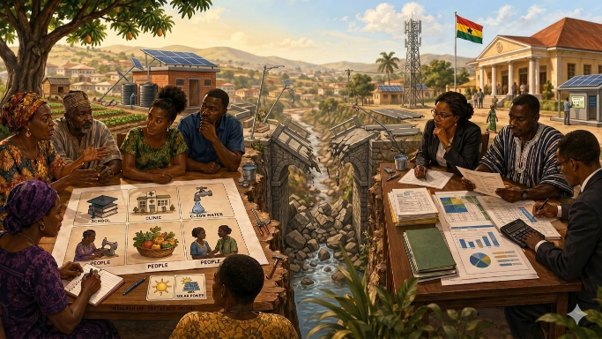
A recurring theme throughout the discussion was the gap that can emerge between participatory planning processes and actual budget decisions. Team members reflected on Buyana’s (2009) argument that local budgeting processes may not always reflect the lived realities and priorities expressed by community members, particularly women, even where mechanisms for participation formally exist.
The conversation drew parallels with experiences in Ghana, where communities may be consulted during planning processes but have limited influence over the allocation of resources once funding decisions become constrained by institutional procedures, earmarked funding arrangements or competing priorities.
Participation Beyond Consultation
The discussion also explored what meaningful participation looks like in practice. Drawing on the Chengdu experience, participants reflected on whether participatory budgeting and local decision-making processes necessarily result in more inclusive and gender-responsive outcomes.
One reflection centred on whether women’s interests are actively sought and incorporated into local planning and budgeting processes. Participants questioned whether greater local control over resources would automatically translate into better outcomes for women, noting that local decision-making structures can reproduce existing inequalities if deliberate attention is not paid to whose voices are heard and whose priorities shape development decisions.
The discussion also prompted reflection on Ghana’s decentralisation framework. While mechanisms such as community action plans and public hearings are intended to provide opportunities for citizen participation, participants observed that community priorities identified through these processes may not always influence final budget decisions. This raised broader questions about the distinction between participation as a procedural requirement and participation as a meaningful influence on decision-making.
More broadly, the conversation highlighted that participation is not simply a matter of creating spaces for engagement. Effective participation requires mechanisms that enable citizens’ priorities to influence decisions and produce visible outcomes. Particular attention was given to how women can participate meaningfully in processes that have historically been shaped by unequal power relations and structural barriers.
This recap forms part of WEE-Ghana’s efforts to strengthen knowledge sharing and document key insights emerging from the project’s internal learning and reflection activities.