
Last week’s commentary examined how climate disasters expose the fragility of women’s livelihoods. This week, we turn to another question: what determines whether communities are resilient long before the floodwaters arrive?
Resilience is Built through Public Spending, Not Emergency Response
When floodwaters rise, emergency response becomes the national priority. It should not be mistaken for resilience. Communities undoubtedly need emergency relief, temporary shelter, medical assistance and humanitarian support. These interventions save lives and deserve every priority. But resilience is not built in the aftermath of disaster.
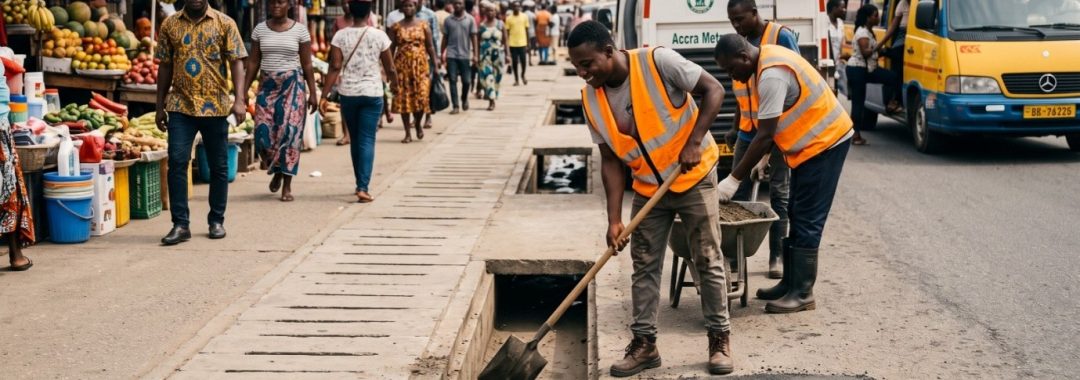
It is built years earlier through decisions about where governments invest public resources. It is reflected in whether drains are maintained before the rains arrive, whether roads remain passable during heavy downpours, whether markets have functioning sanitation and drainage systems, and whether public infrastructure is designed to withstand increasingly frequent climate shocks.
Viewed this way, flood resilience is not simply an environmental concern. It is a question of public spending.
This perspective emerged consistently throughout WEE-Ghana’s work on fiscal policy. Although the project initially sought to understand women’s experiences of taxation and public expenditure, discussions repeatedly demonstrated that communities rarely separate revenue collection from public spending. What mattered most to participants was whether the resources they contributed translated into visible improvements in their everyday lives.
One participant captured this relationship succinctly: “You cannot look at revenue, and then the spending independently… we need to think about a more holistic way… of conducting fiscal policy.”
That observation reaches well beyond fiscal management. It speaks directly to climate resilience. Communities do not become resilient simply because floods are inevitable. They become resilient because years of sustained public investment have reduced their exposure to risk. Functional drainage systems, reliable roads, well-maintained markets and effective sanitation infrastructure are not emergency interventions. They are the cumulative result of long-term public policy choices.
For women working in Ghana’s informal economy, these investments carry particular significance. How, one may ask? Markets are more than commercial spaces. They are workplaces. Roads are more than transport corridors. They connect farmers to buyers, traders to customers, mothers to healthcare facilities and households to essential services. When these systems fail, the economic costs fall most heavily on those whose livelihoods depend on them every day.
Yet WEE-Ghana’s research uncovered another equally important dimension of resilience.
Across several communities, discussions repeatedly returned to a simple but profound question about public accountability. Traders did not merely speak about paying taxes and levies. They questioned whether those payments were being translated into tangible improvements within their communities.
A key sentiment echoed in the markets was, “If we are paying so much in the markets, how come we don’t see the impact of the taxes or the levies?”
Reflecting on conversations with market women during fieldwork, a researcher lamented that many vendors had become increasingly reluctant to pay levies because: “…they didn’t see what the levies were being used for.”
Their concerns extended beyond taxation itself. They pointed to broken sanitation facilities, unreliable water supply, deteriorating market infrastructure and inadequate maintenance as evidence that the benefits of public revenue collection were often difficult to see.
These conversations illuminate what public finance scholars describe as the fiscal social contract—the relationship between citizens who contribute public revenues and governments that convert those revenues into public goods and services.
The contract is sustained not only through legislation, but also through trust.
When communities see drains cleared before the rainy season, markets maintained, roads repaired and public services functioning, taxation is more readily understood as a collective investment in shared wellbeing. When those visible improvements are absent, confidence in public institutions inevitably weakens.
From a women’s economic empowerment perspective, this relationship matters enormously.
Public spending influences far more than infrastructure. It determines whether traders can reopen quickly after floods. It shapes whether transport networks remain operational enough for women to access markets. It influences whether businesses recover within days—or struggle for months. Investments in resilient infrastructure therefore protect not only physical assets, but also the livelihoods upon which countless women depend. Flood resilience, then, cannot be understood only through the language of disaster management. It must also be understood through budgets, governance and accountability.
Climate adaptation begins long before the first storm arrives. It commences with public investment decisions that strengthen communities before disaster strikes and reduce the economic vulnerabilities that floods so often expose.
Looking Ahead
Public investment can reduce vulnerability, but it cannot eliminate every shock. Even resilient communities need mechanisms that help households recover when disasters occur. In the final instalment of the WEE-Ghana policy lens, we explore why financial resilience—from savings and insurance to social protection—is essential to ensuring that climate shocks do not become long-term economic setbacks for women.