
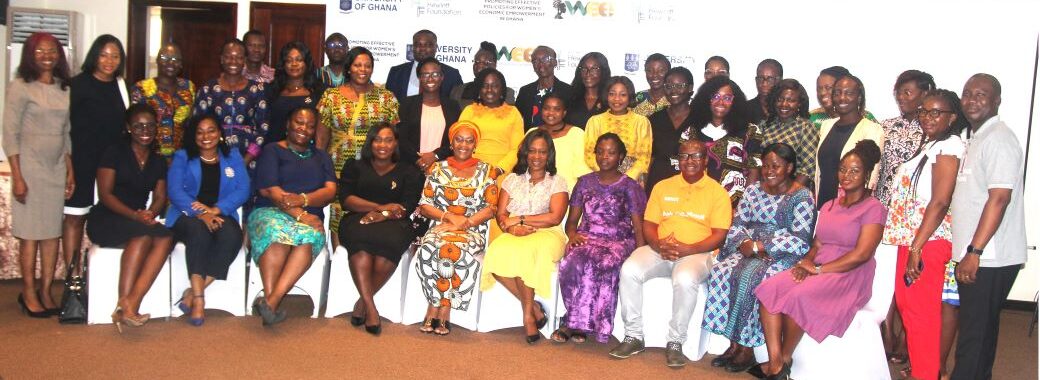
Efforts at transforming the economic fortunes of the Ghanaian woman has received a renewed and significant boost with the “Promoting Effective Policies for Women’s Economic Empowerment in Ghana” (WEE-Ghana) project. This project represents a holistic and multi-dimensional approach to achieving sustained gains in economic prosperity for Ghanaian women.
At the project’s inception forum, held at the African Regent Hotel in Accra, on 30th April, 2024, a broad spectrum of key stakeholders drawn from various spheres of society convened to deliberate on collaborative pathways for achieving the project’s goals, objectives and overall success.
Addressing the forum, an Associate Professor of Sociology at the University of Ghana, Professor Akosua Darkwah, drew attention to the various ways in which the state’s actions could, either undermine or promote women’s economic empowerment.
She noted, “Various studies have signalled how economic reforms by the Ghanaian state, for example, shrunk public sector jobs, and undermined the extent to which education served as a path to empowerment for younger Ghanaian women. More recently, state efforts at reducing the negative impact of COVID-19 on Ghanaian citizens was discovered to have gendered outcomes with women less likely to benefit from the provisions the state made.”
“In other jurisdictions, such as Nairobi, Kenya, subsidised child-care significantly increased the percentage of women who joined the workforce, while more Ecuadorian wives were found to own couple’s wealth due to the institution of a partial community property regime.”
The Co-Principal Investigator for the WEE project underscored the importance of paying closer attention to the macro-level decision making efforts of policy makers and explore its micro-level impact on women. This wis pivotal to making “better concerted efforts to design policies that ultimately empower women.”
In the ensuing deliberative session, the participants lauded the project’s comprehensive approach towards addressing the policy formulation and implementation gaps constraining the economic empowerment of the average Ghanaian woman. They pledged their commitment and proffered various ways in which their collective efforts could culminate in the achievement of the project’s ultimate goal of achieving a critical mass of economically empowered women in Ghana.
A participant observed, “The public sector is in the process of developing a comprehensive gender strategy, so it will be good for the project to take on board some of the issues captured in that document.”
WEE is a nation-wide project on women’s economic empowerment featuring research, policy engagement, and network-building among women’s rights organisations and key female figures across Ghana’s business and finance landscape. It spans a three-year period and aims at achieving a critical mass of economically empowered women in Ghana through the advancement of gender-responsive policy making. To achieve this goal, the project’s Co-Leads, anticipate collaborative work with policy makers, the Network for Women’s Rights in Ghana (NETRIGHT), key female figures in business and finance, as well as WEE advocates. The project is led by a team of feminist social scientists (Prof. Akosua K. Darkwah, Prof. Abena Oduro, and Prof. Dzodzi Tsikata), together with early career researchers and post-doctoral fellows, who are collectively committed to working together to produce evidence and co-create policy solutions to positively change the economic fortunes of Ghanaian women.