
Preliminary Insights from the WEE-Ghana Project
Every day, thousands of informal sector workers in Ghana pay market levies and fees—but what do these payments reveal about how fiscal systems shape women’s economic opportunities?
Understanding how these everyday payments function requires recognising the specific nature of local revenue systems in Ghana. At the district level, many of the payments traders make are not formal income taxes but fees, levies, or tolls collected by district assemblies. These payments may include market tolls, stall fees, or charges associated with the use of trading spaces. Although these levies are relatively small, they form an important component of internally generated funds (IGF) for district assemblies. These revenues are used to support local services such as sanitation activities, market maintenance, and minor infrastructure improvements.
Fiscal policy—how governments raise revenue and how they allocate public expenditure –plays a central role in shaping economic opportunity. Tax revenues finance public services, infrastructure, and social programmes that influence livelihoods and access to economic resources. Yet the effects of fiscal policy are not always experienced equally by women and men. Women and men often participate in different segments of the economy, operate under different constraints, and carry different responsibilities within households and communities. As a result, fiscal policies that appear neutral may have distinct implications for women’s economic opportunities and economic security.
The WEE-Ghana Project examines these dynamics by assessing the impact of fiscal policy on women’s economic empowerment in Ghana. Drawing on interviews and focus group discussions conducted with primarily informal sector workers—particularly traders—and district-level policymakers, the project investigates how taxation, public spending programmes, and local decision-making processes shape everyday economic lives.
This blog series shares preliminary insights from the project’s field research, focusing on two interconnected dimensions of fiscal policy: domestic revenue mobilisation and public spending.
The series explores two questions:
- How do informal sector workers experience taxation at the local level?
- What challenges arise when tax systems interact with informal economic activity and the diversity of traders within it?
Together, these discussions provide insight into how fiscal systems operate in practice and what these dynamics may mean for advancing women’s economic empowerment in Ghana.
We begin with the most immediate point of contact between informal sector workers and the fiscal state: the fees and levies collected in Ghana’s markets.
Part 1
Fees, Levies, and the Local Fiscal Social Contract
Understanding these payments requires recognising the nature of local revenue systems in Ghana. At the district level, traders typically pay fees, levies, or tolls collected by district assemblies as part of internally generated funds (IGF), which support local services such as sanitation, market maintenance, and minor infrastructure improvements.
For many people in Ghana, the most visible interaction with the tax system does not occur through personal income taxes deducted from formal salaries. Instead, it takes place in local markets and trading spaces, where traders regularly pay levies or tolls collected by district assemblies.
These payments may appear small—a daily toll paid by traders selling vegetables, cooked food, clothing, or household goods. Yet they represent one of the most direct points of interaction between informal sector workers and public institutions. For many traders, the collection of market levies is the most immediate way in which the fiscal state becomes visible in everyday economic life.
Local markets are not only centres of commercial activity; they are also important spaces of women’s economic participation. Across many parts of Ghana, women dominate petty trading and small-scale retail activities. Market trade accounts for nearly 40 percent of women’s employment in urban areas and about 30 percent nationally, underscoring its central role in women’s livelihoods. These activities provide income for households and support a wide range of local supply chains linking rural production with urban consumption. As a result, the conditions under which markets operate—including infrastructure, sanitation, and regulation—have direct implications for women’s economic livelihoods.
Understanding how traders experience taxation in these spaces therefore offers an important entry point into examining how fiscal systems intersect with women’s economic empowerment.
As part of the WEE-Ghana Project’s ongoing research on fiscal policy and women’s economic empowerment, interviews and focus group discussions were conducted with informal sector workers—particularly traders operating in local markets—as well as district-level policymakers across several regions. These conversations provide early insights into how people experience taxation and public revenue systems in their everyday economic activities.
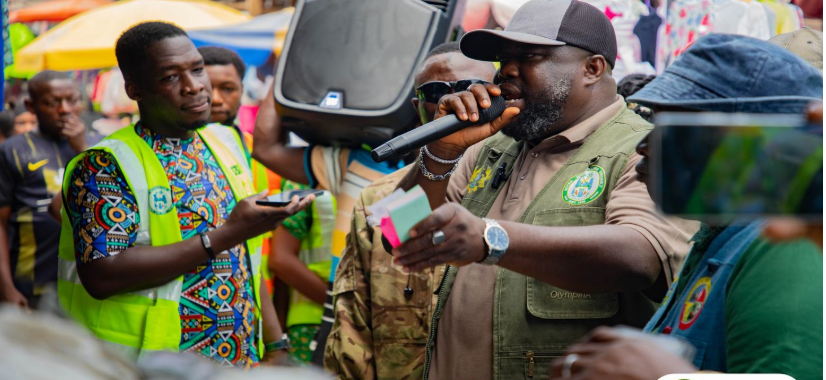
Market levies are paid directly by the traders to tax collectors who come to the markets for this purpose. In several markets, participants described how collectors move through trading spaces recording payments and issuing receipts. While traders were aware that they were required to pay levies, many could not explain how these payments were determined, how levy rates were set, or how the revenues collected were ultimately used by district assemblies. This gap between awareness of their responsibilities as taxpayers and knowledge of the taxation process and revenue utilisation is significant because taxation is not only a technical fiscal process. It is also part of a broader relationship between citizens and the institutions responsible for managing public resources.
This relationship is often described as the fiscal social contract. In its simplest form, the fiscal social contract suggests that citizens are more willing to pay taxes when they believe that public institutions are using those resources responsibly to provide public goods and services. Roads, sanitation services, water systems, and market infrastructure are all examples of public goods that can be financed through taxation. When taxpayers can clearly see how their contributions translate into improvements in these services, taxation is more easily understood as a collective contribution to shared development.
Where this connection is less visible, trust in the system may weaken. In several markets visited during the fieldwork, traders pointed to market environments where sanitation facilities were not functioning, waste collection was irregular, or access to water remained limited. In these contexts, respondents sometimes expressed frustration about paying levies while seeing little improvement in the infrastructure that supports their economic activities.
Although taxation systems rely on formal laws and administrative structures, they also depend on public trust and perceptions of fairness. When taxpayers believe that revenues are used transparently and effectively, compliance becomes easier to sustain. When the link between taxation and public services appears unclear, the legitimacy of the system may be questioned. This observation suggests that compliance at the local level is shaped by both administrative enforcement and perceptions of fairness. The presence of collectors ensures that payments are made, but perceptions of how revenues are used influence how traders interpret the legitimacy of those payments..When traders pay levies but do not see corresponding improvements in these conditions, they may question whether the system adequately supports their economic activities.
What challenges emerge when tax systems interact with informal economic activity and the diversity of traders within it? This is a question we take up in the next piece in this series.
Continue the Conversation
Follow the WEE-Ghana blog series for further insights into how fiscal policies—including taxation and public spending—intersect with women’s economic empowerment in Ghana.
Photo Credit: Accra Metropolitan Authority