

“Without a gender lens, policies designed to promote financial inclusion risk overlooking the distinct financial realities and needs of the people they are intended to serve.”
This observation by Patricia Blankson-Akakpo, Head of Secretariat of the Network for Women’s Rights in Ghana (NETRIGHT), a partner organisation in the WEE-Ghana Project, draws attention to a critical issue in discussions on digitalisation and financial inclusion: the need to understand how policies affect women and men differently.
As Ghana continues to embrace digital technologies and expand access to financial services, discussions around financial inclusion often focus on increasing access. Yet, as Patricia reminds us, access alone is not enough. The real question is whether the systems, services, and policies being developed are responding to the different realities and needs of the people they are intended to serve. Indeed, this is where a gender lens becomes essential.
When policies are designed without considering how women and men experience economic opportunities differently, they risk missing the mark. What appears inclusive on paper may fail to address the specific barriers that prevent women from fully participating in and benefiting from financial systems.
Patricia’s perspective resonates strongly with conversations emerging from WEE-Ghana’s recent policy dialogue on digitalisation and financial inclusion, which brought together diverse stakeholders to reflect on what the project’s research means for advancing women’s economic empowerment in Ghana.
Findings from the research presented at the convening showed that although the nation has made significant progress in digitalisation and financial inclusion, access to and benefits from these advances remain uneven. Across the study communities, participants reported challenges including unreliable infrastructure, limited digital literacy, high transaction costs, concerns about fraud, and unequal access to digital tools and services. The findings also revealed that these barriers often affected women more profoundly, limiting their ability to fully participate in an increasingly digital economy.

Stakeholders shared perspectives on financial inclusion
Building on these findings, participants reflected on how these challenges manifest in everyday life and what they mean for efforts to promote inclusive digital and financial systems. For older women and women with limited formal education, navigating digital platforms can be particularly difficult. Many rely on family members, friends, or service providers to help them complete transactions and access services that are increasingly being delivered through digital channels. In such situations, the promise of digital inclusion does not always translate into genuine empowerment.
A case in point is how financial inclusion is often discussed in terms of technology, banking products, and digital platforms. However, the experiences shared during the research remind us that inclusion is ultimately about people. It is about whether women can access and use services independently, whether they feel safe using them, whether they can afford them, and whether those services help them improve their economic circumstances.
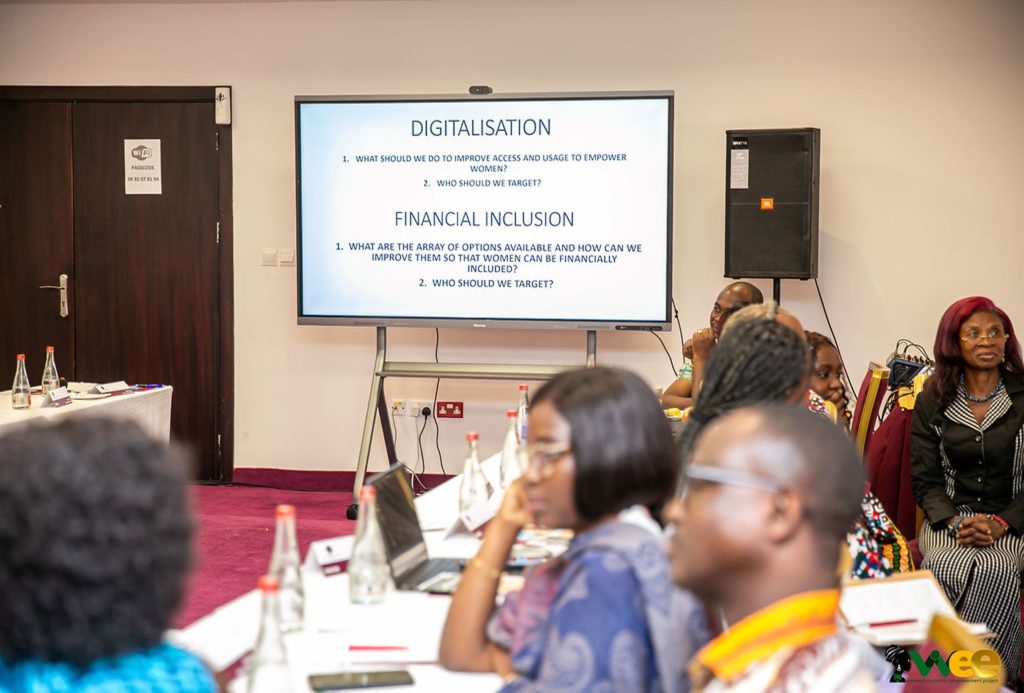
Key themes from the policy dialogue
As the nation continues its digital transformation journey, ensuring that these questions remain central to policy discussions will be critical. It also puts into sharp focus the importance of the work being undertaken by NETRIGHT within the WEE-Ghana Project.
NETRIGHT’s contribution centres on advancing gender-responsive advocacy aimed at addressing the structural and systemic barriers that continue to affect women’s economic empowerment. Patricia notes, “Once findings are shared, NETRIGHT engages with them and uses them to strengthen the capacity of a core group of civil society organisations, particularly women’s rights organisations working in the area of women’s economic empowerment.” By equipping these organisations with relevant knowledge and the skill to craft advocacy messages, NETRIGHT seeks to contribute to policy conversations that are not only grounded in evidence, but also result in meaningful and gender-responsive reforms.
Patricia’s reflection serves as a timely reminder that Ghana’s financial inclusion narrative requires a rethink—one that goes beyond expanding access to designing systems and policies that recognise and respond to the different realities women face. Only then can financial inclusion fulfil its promise as a meaningful pathway to women’s economic empowerment.