
Over the past three weeks, the WEE-Ghana policy lens has explored how climate disasters expose interconnected dimensions of women’s economic empowerment—from the hidden burden of unpaid care work to the fragility of livelihoods and the importance of sustained public investment. In this final instalment, we examine why recovery ultimately depends on financial resilience.
Recovery Requires Financial Resilience
Floodwaters eventually recede; however, financial vulnerability often remains. Merchandise has been destroyed. Equipment has been damaged. Crops have been lost. Savings intended for children’s education, healthcare or business expansion are redirected towards immediate survival. While the visible signs of flooding may disappear within days, the financial consequences can linger for months, slowing recovery long after the headlines have faded.
Recovery, therefore, depends on more than rebuilding damaged infrastructure.
It depends on whether households have the financial resilience to absorb unexpected shocks without sacrificing years of hard-earned economic progress.
This was a recurring theme in WEE-Ghana’s conversations on women’s employment, financial inclusion and social protection. Participants at stakeholder convenings consistently observed that many women in informal employment operate with little financial cushion, making it difficult to recover from unexpected disruptions. As one researcher reflected after reviewing the fieldwork, women in vulnerable employment frequently “have difficulty estimating incomes” because their earnings are continually reinvested in sustaining both their enterprises and their households.
These realities help explain why formal financial protection often remains beyond the reach of many women. Discussing participation in Ghana’s pension system, one participant offered a simple but revealing second-hand account:
“For the SSNIT scheme you need money to do that and they do not always have money.”
The statement illustrates a broader challenge. Financial inclusion is not simply a question of awareness or access to financial products. It is also shaped by whether people’s incomes are sufficiently stable to allow them to save consistently, contribute to pension schemes or build reserves for future emergencies.
Participants repeatedly cautioned against assuming that greater financial literacy alone would solve this problem. WEE-Ghana’s research found that low and unpredictable incomes themselves constrain women’s ability to participate consistently in formal financial protection systems. Strengthening financial resilience therefore requires policies that address both access to financial services and the underlying economic conditions that determine whether those services are affordable and meaningful.
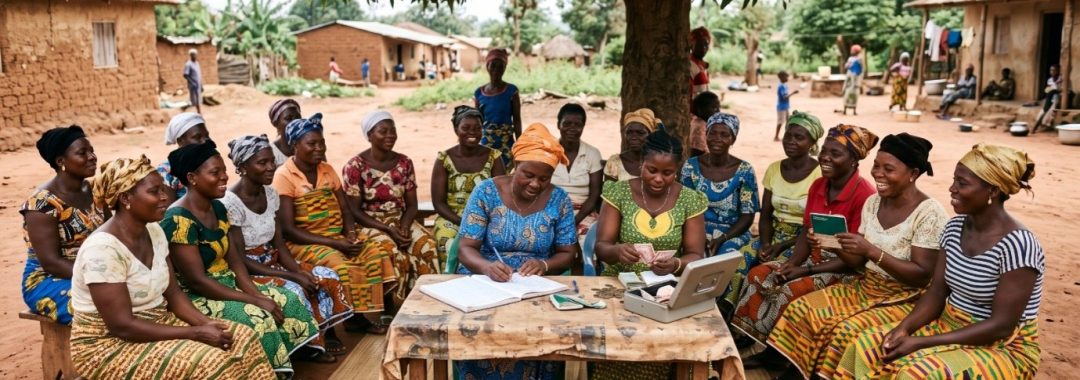
At the same time, the research highlighted important sources of resilience already embedded within communities. Women frequently pointed to susu groups, rotating savings schemes and other community-based financial arrangements as practical mechanisms that helped them accumulate resources, support one another and invest in their livelihoods. These locally organised systems often reflected the realities of informal work more effectively than conventional financial institutions. As one example shared during the convenings illustrated, regular contributions to a community savings scheme enabled women to build a pool of resources that remained untouched until the end of the year, providing much-needed capital for both household and business needs.
These experiences suggest that strengthening financial resilience requires more than expanding access to formal banking services. It also requires recognising and supporting the financial strategies that women have already developed to manage uncertainty. Flexible savings mechanisms, accessible social protection, appropriately designed financial services and stronger support for community-based initiatives all form part of a broader resilience strategy.
For women navigating increasingly frequent climate shocks, resilience is measured not simply by whether businesses reopen after floods. It is measured by whether recovery is possible without sacrificing years of hard-earned economic progress.
Beyond the Floodwaters
The recent call for gender-responsive flood policies is a timely reminder that climate disasters are never gender neutral. Yet, as the WEE-Ghana Project’s research demonstrates, building resilience requires far more than responding differently once disaster strikes.
It hinges on a recognition of the systems that shape vulnerability long before the rains arrive.
Care systems influence who bears the invisible labour of recovery. Employment conditions determine whose livelihoods can withstand disruption. Public spending shapes the quality of the infrastructure that protects communities before disasters occur. Financial systems influence whether households can recover from shocks without sacrificing years of hard-earned economic progress.
Together, these policies determine whether climate shocks become temporary setbacks or long-term reversals in women’s economic empowerment. Scrutinised through the WEE-Ghana policy lens, the conversation therefore shifts.
Flood resilience is no longer only an environmental concern or a disaster management challenge. It becomes a question of economic governance, social policy and public investment. It asks not only how Ghana responds when floods occur, but how policy can reduce vulnerability before disasters strike and strengthen the resilience of those most exposed to their consequences.
Perhaps the most important lesson emerging from WEE-Ghana’s work is that public policies rarely operate in isolation. Investments in drainage systems influence women’s employment. Care policies shape labour market participation. Fiscal policy determines the quality of public infrastructure. Financial inclusion affects the ability of households to recover after crises. When viewed together, these interconnected policies create—or constrain—the conditions under which women can participate fully, productively and securely in economic life.
Climate change is making extreme weather events more frequent and more severe. Responding effectively will require more than stronger embankments, improved drainage systems and faster emergency response. It will require policies that recognise care as economic infrastructure, protect informal livelihoods, invest in resilient public services and strengthen the financial and social protections that enable women to withstand and recover from increasingly frequent climate shocks.
Floods ultimately reveal far more than weaknesses in drainage systems.
They reveal the strengths—and the weaknesses—of the policies that shape everyday life. They expose whose work remains invisible, whose livelihoods remain precarious and whose resilience is quietly assumed rather than deliberately supported.
The question, then, is not simply whether Ghana will build more resilient cities. It is whether it will build more resilient lives.