
What does a recent call for gender-responsive flood policies reveal about women’s economic empowerment? Through the lens of WEE-Ghana’s research, far more than might first appear.
Every rainy season, flooding returns to Ghana’s national conversation. Images of submerged homes, impassable roads, collapsed drains and displaced families dominate news bulletins and social media feeds. This year has been no different.
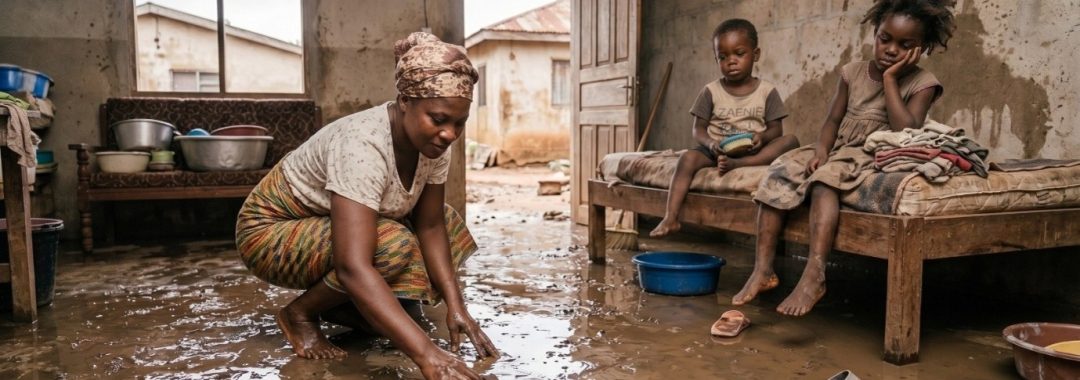
In a Daily Graphic feature published on 25 June 2026, journalist Biiya Mukusah Ali reported on a call by the Executive Director of the African Centre for Urban Resilience Planning and Inclusive Governance (ACURPIG), Gifty Nyarko, for gender-responsive flood policies that better protect women and children. The Executive Director argued that women often shoulder the greatest burden when floods occur—not only because they are more exposed to risk, but because they are expected to care for children, support elderly relatives, secure food and water, salvage household belongings and rebuild family livelihoods in the aftermath of disasters.
The article draws attention to an important reality: climate disasters are never experienced equally. Existing social and economic inequalities shape who is most exposed, who recovers first and who bears the invisible costs long after the floodwaters recede.
Yet if we stop there, we risk missing the larger story.
Over the past three years, the WEE-Ghana Project has examined how public policy shapes women’s economic opportunities and outcomes. Viewed through that body of research, the Daily Graphic story becomes more than a report on flood preparedness. It becomes an entry point for understanding how climate resilience intersects with women’s economic empowerment.
Over four instalments, this policy lens series explores that story from four perspectives. We begin where the burden of every disaster often begins—but is least visible: care.
When the Waters Rise, Care Work Rises Too
The first images that accompany floods are usually physical: submerged roads, damaged homes, collapsed drains and stranded commuters. Less visible are the responsibilities that begin almost immediately after the waters rise.
Children still need to be cared for when schools close. Elderly relatives still require support. Meals still need to be prepared, even when kitchens have flooded. Homes must be cleaned, belongings salvaged and families reassured while communities begin the slow process of recovery.
More often than not, that work falls to women. While Gifty Nyarko’s call for gender-responsive flood policies recognises that women and children experience climate disasters differently, WEE-Ghana’s research suggests an equally important question: what does this tell us about how public policy understands care itself?
Across the project’s stakeholder engagements, one message surfaced repeatedly. Care cannot continue to be treated as a private household responsibility with little relevance to economic policy. Participants instead argued that care is foundational to economic planning because it sustains the workforce on which every economy depends. Care enables economies to function.
Just as roads enable trade and electricity powers businesses, care enables parents to work, entrepreneurs to run their enterprises and communities to remain productive. Yet because much of this work takes place within households—and is performed predominantly by women—it often remains invisible in economic planning.
Stakeholders challenged the assumption that caregiving belongs naturally to women and argued instead that care should be recognised as a shared societal responsibility requiring deliberate public investment, supportive institutions and a more equitable distribution of caregiving between women and men. Indeed, floods expose why these conversations matter.
Every additional hour spent caring for displaced children, supporting sick relatives or restoring flood-damaged homes is an hour that cannot be devoted to farming, trading or running a small business. Climate disasters do not create this burden. They magnify one that already exists.
Recognising care as economic infrastructure fundamentally changes how we think about resilience. It shifts the conversation from responding to disasters towards investing in the systems that allow women—and by extension households, communities and economies—to recover more quickly and more equitably.
Looking Ahead
The flood story does not end with care. When homes, roads and markets are disrupted, livelihoods are disrupted too.
In the next instalment of the WEE-Ghana policy lens, we examine how climate disasters expose the fragility of women’s livelihoods—and why economic resilience requires more than rebuilding infrastructure.