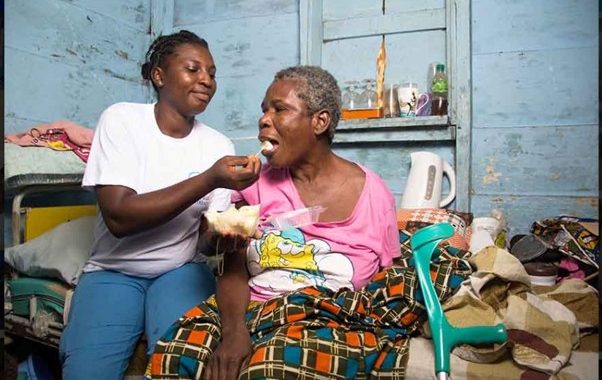
Care extends across the life course, shaping the time and conditions under which women participate in economic life. Photo: Care for Aged Outreach – Ghana (Care4Aged)

From Care Gaps to Care Systems: What Would a More Equitable Care Economy Require?

From Individual Coping to Shared Responsibility

If women are continually filling gaps in care provision, the answer cannot simply be to ask them to cope better. Nor can it be limited to encouraging families to share responsibilities more equitably, important as that may be. A more fundamental question is whether Ghana’s policies and institutions are organised in ways that adequately support the care work on which households and the wider economy depend.

WEE-Ghana’s work suggests that the answer requires looking at care across multiple sites rather than treating it as the responsibility of a single institution or sector. Care takes place in households, communities, markets, workplaces and public institutions, and it can be paid or unpaid. That means a functioning care system cannot be built through one intervention alone. It requires coordination across the policies and institutions that shape how people work, live, raise children, care for relatives and participate in economic life.

Investing in Care—and in Those Who Provide It

WEE-Ghana’s care framework has emphasised recognition, reduction, redistribution and remuneration as interconnected dimensions of addressing unpaid care. One starting point is to reduce the amount of time and effort required for necessary care and domestic work. WEE-Ghana’s work has drawn attention to practical interventions that can reduce the time women spend on domestic tasks, including reliable water access, improved cooking technologies and accessible, affordable energy supply. Such investments matter because they can release time that women might otherwise spend on unpaid work. The same principle applies to accessible childcare, health services, support for older persons and appropriate services for persons with disabilities. Together, these interventions contribute to women’s economic empowerment by shaping the time and conditions under which women can participate in economic activity

A second requirement is redistribution. Care cannot become more equitable simply by recognising women’s unpaid contribution while leaving them responsible for performing most of the work. Redistribution means considering how responsibility can be shared across households, men and women, communities, employers, markets and the state. It also means asking whether policies intended to support care reach the women who need them most. The experience of maternity and paternity leave has already demonstrated why this matters: protections attached primarily to formal employment can leave many women outside their reach, particularly those working in Ghana’s large informal economy.

A third requirement is investment in care as a sector and source of decent work. Care is already an economy, encompassing formal and informal services and paid and unpaid activities. Yet paid care work can itself be poorly remunerated, reflecting the same social assumptions that have historically feminised and undervalued care. WEE-Ghana’s work has pointed to the potential of developing professional caregiving through existing training institutions. The project’s discussions raised a practical policy question: “could we be intentional as a country in training people to have the expertise and the skills to provide different forms of care?” Such an approach could simultaneously expand the availability of care services and create employment and skills-development opportunities.

From Fragmented Provision to Policy Action

But building a more equitable care economy also requires policy visibility and coordination. Care cuts across multiple areas of policy, from health and social protection to employment, disability, childcare and local services. WEE-Ghana’s policy engagement has therefore drawn attention to the fragmentation of the policy landscape, captured starkly in the observation that the nation lacks a comprehensive care policy. Whether this is addressed through a standalone policy or stronger integration of care across existing policy frameworks, the underlying issue remains important. If responsibility is dispersed across different sectors and institutions, there must be sufficient coordination to ensure that gaps do not arise simply because care responsibilities span multiple institutional mandates.

Visibility also matters for financing. If women continue to absorb care gaps privately, policymakers can underestimate the scale of the problem. This is precisely what makes care deficits difficult to see: women continue to stretch themselves to fill them. Better data on time spent on unpaid care and employment and the economic consequences of care responsibilities can therefore help make those hidden costs visible.

The financing question is equally important. A more equitable care system cannot depend indefinitely on households absorbing the costs themselves. At the same time, public policy must be designed carefully so that support is sustainable, equitable and responsive to different care needs. WEE-Ghana’s policy engagement raises a fundamental question about priorities and resources: “If we do really value care, then we can allocate some resources to give us some basic level of care.” The point is not that public resources are unlimited. It is that what society chooses to value must ultimately be reflected in priorities, resource allocation and implementation.

This is also why the scholarship debate should not be reduced to the question of whether public funds should have been used to support the families of scholarship beneficiaries. That controversy raises legitimate questions about accountability and the proper use of public resources. But viewed through the WEE-Ghana care lens, it also exposes a more fundamental policy dilemma: what happens when women are given opportunities without sufficient attention to the care arrangements that enable them to take those opportunities up? The answer cannot be to assumed that women will simply find a way, because “finding a way” is often precisely how unpaid care burdens remain invisible.

A more equitable care economy would therefore not be one in which government assumes every responsibility. It would be one in which care is recognised, measured, supported, redistributed and appropriately resourced, with different actors taking responsibility for the parts they are best positioned to provide. It would recognise that households matter, but that households cannot indefinitely compensate for gaps in public services, labour-market protections and affordable care provision. It would also recognise that women are not an unlimited reserve of unpaid labour.

Ultimately, women’s economic empowerment is not only about whether women are offered opportunities. It is about whether the conditions surrounding those opportunities allow them to take them up, sustain their participation and benefit from them without carrying disproportionate and invisible costs. Ama’s scholarship dilemma is therefore not an isolated problem. It is a window into a much broader question about how Ghana organises care. If women must continually absorb the gaps in the care system, the question is not whether they are resilient enough. It is whether the system is working well enough. And perhaps that is where the conversation about care needs to move next: from asking women to cope with care, to designing systems that help them do so without absorbing the costs alone.

Ama is a composite character used in this series to illustrate the policy questions raised by the scholarship debate; she does not represent any individual scholarship beneficiary
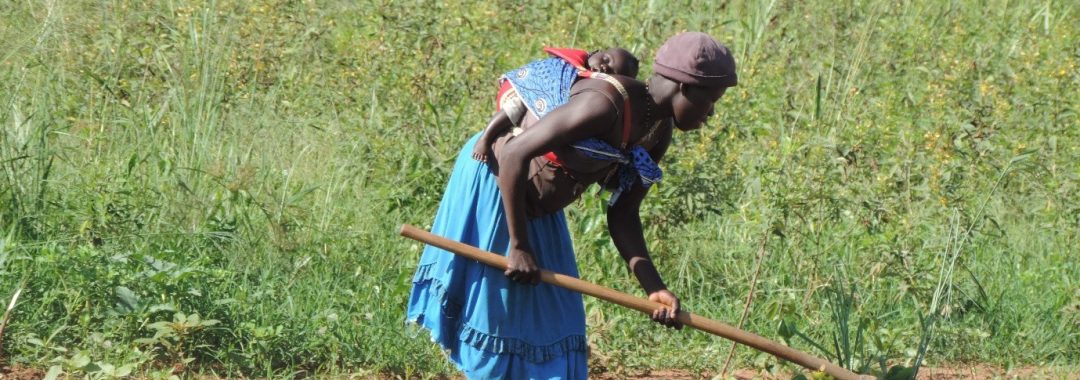
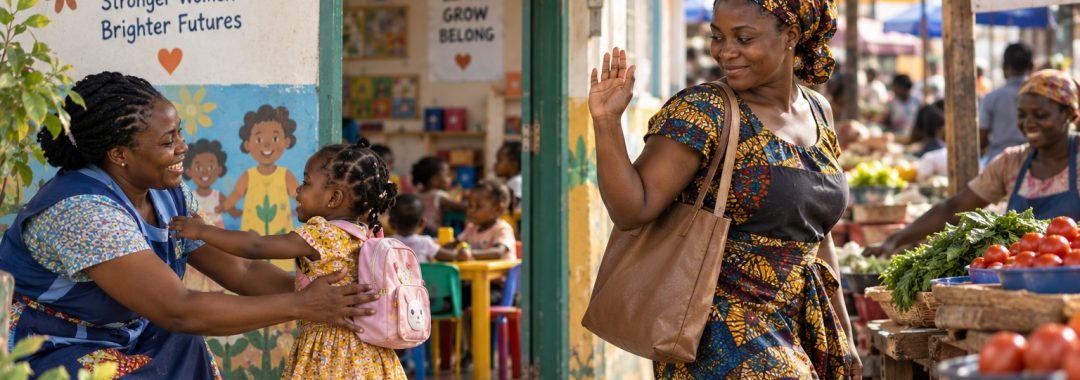
A woman working in a field in Northern Uganda while carrying a baby on her back (Photo: Leo Odongo / Wikimedia Commons, CC BY-SA 4.0)

When Women Fill the Gaps: What Happens When Care Systems Rely on Unpaid Labour?

The Hidden Cost of Coping

When a mother leaves home early to take a child to school before going to work, when a grandmother steps in to care for grandchildren, when a daughter reduces her working hours to look after an ageing parent, or when a woman quietly turns down an opportunity because there is nobody else to provide the care her family needs, these decisions can appear personal. They may be described as family arrangements, individual choices or sacrifices made for loved ones. But taken together, they reveal something larger about how care is organised in society.

WEE-Ghana’s work has highlighted a striking paradox: women often stretch themselves to provide care that the state or the market is not providing. In doing so, it becomes difficult to see the gaps in care provision. As the project captured through its engagement with stakeholders, “we don’t really see the care deficits” because women continue to stretch themselves to fill them. What may look like resilience at household level can therefore conceal a much deeper systemic gap: the problem has not disappeared; its costs have simply been absorbed within households, often through women’s time and labour.

The implications become clearer when we return to Ama, the woman at the centre of our scholarship story. Suppose she accepts her opportunity to study abroad and leaves her children in Ghana. Her children still need to be cared for. Her mother may step in. Her sister may help. Her husband may reorganise his own responsibilities. Another relative may take on the role. Or the family may pay someone to provide care. Each arrangement solves an immediate problem, but each also transfers the responsibility somewhere else. If the person taking over is another woman, her own time and economic activity may be affected. If care is purchased, the household assumes an additional financial cost. If neither option is available, Ama may have to reconsider the opportunity itself. The point is not that families should stop caring for one another. It is that when households repeatedly absorb gaps in care provision, the economic cost of those gaps does not disappear; it is redistributed, often invisibly.

When Care Takes Time, Opportunity Costs Follow

Care constraints do not always look like childcare. They can be embedded in the everyday work required to keep households functioning. WEE-Ghana’s work has drawn attention to the less visible ways in which domestic responsibilities consume women’s time. The project’s engagement highlighted how “the issue of water and the issue of fuel firewood takes huge chunks of hours away from women and affects the ability to participate in economic activity.” The broader point is important: time devoted to necessary unpaid work is time that cannot simultaneously be devoted to paid employment, enterprise, education or other opportunities.

This is why the question of care cannot be reduced to whether women are working or whether they have access to economic opportunities. It must also consider what happens around those opportunities. WEE-Ghana’s work recognises that care involves time, effort and resources and takes place across households, markets, public institutions and voluntary settings. Much of it remains unpaid. That unpaid component is particularly significant because it can obscure the extent to which households are effectively subsidising the wider economy through women’s time. Women’s unpaid care work (childcare, eldercare, care for the sick, preparing meals, cleaning the home) is critical for the maintenance and quality of the current and future workforce. The profitability of firms and businesses depends on the quality of the workforce as does the productivity of the economy. Women’s unpaid care labour is therefore a subsidy to firms and businesses and to the economy. If a monetary value were to be placed on women’s unpaid care work, the wages paid to workers would have to be higher to cover the total cost of maintaining labour on a daily basis. A woman who remains at home to care for or bring up a child is not simply “not working”. A daughter who leaves paid employment to care for an ageing parent is not simply making a private family choice. Their time has been redirected towards work that remains necessary whether or not it is recognised as economic activity.

The problem becomes even more pronounced when care needs are intensive or prolonged. During WEE-Ghana’s work, the project has recognised that care cannot simply be stretched indefinitely. As responsibilities accumulate, stress increases and care deficits can emerge. For some households, this may mean reduced working hours or lost income; for others, it may mean relying increasingly on relatives, neighbours or informal arrangements. Families caring for persons with severe disabilities may face particularly demanding circumstances, with caregivers requiring substantial time even when they are themselves economically active. The capacity of households to cope should therefore not be mistaken for evidence that the underlying system is adequate.

When Private Coping Becomes a Systemic Problem

There is also a danger in celebrating women’s ability to cope without asking what that coping requires. If women continually adjust their employment, businesses, education and personal time around gaps in care provision, the flexibility of the household can become a substitute for institutional responsibility. The burden is private and takes its toll on women’s bodies. It depletes them of good health. This depletion is particularly evident when women combine income-generating work with unpaid care work. A woman may spend the day running a business or earning an income and then return home to prepare meals, clean the household and care for children, an ageing parent or a sick family member. The demands of both forms of work are borne by the same person, and the toll extends beyond her economic circumstances to her physical, mental and emotional wellbeing. Over time, this depletion can be reflected in lower incomes, constrained labour-force participation, interrupted careers, reduced productivity and fewer opportunities to build economic security.

This brings the scholarship debate into sharper focus. The question raised by Ama’s situation is not simply whether a scholarship should finance dependants. Nor is it whether women with children should be expected to make private arrangements. The deeper issue is what the existence of these dilemmas tells us about the care arrangements surrounding women’s economic opportunities. When women must continually solve care problems privately in order to participate in education and employment, what appears to be an individual challenge may actually be a systemic gap. And once we see that gap, another question follows: what would it take to move from households continually finding ways to cope to a care system deliberately designed to support them?

Ama is a composite character used in this series to illustrate the policy questions raised by the scholarship debate; she does not represent any individual scholarship beneficiary.

Care and Scholarship Instalment

Who Should Carry the Cost of Care? Rethinking Care as an Economic Policy Issue

If care makes economic participation possible, can it remain a private problem?

That is the question that follows the story of Ama. In the previous instalment of the WEE-Ghana Policy Lens, we considered what happens when a woman receives an opportunity to pursue postgraduate education while still carrying responsibilities for children or other dependants. If Ama leaves her children behind, someone else must provide the care; if she takes them with her, the cost of maintaining the family increases. Either way, the care does not disappear. It is reorganised, transferred or paid for. One may therefore ask: why should Ama’s ability to participate in economic life be a matter of public policy rather than a private affair? It is precisely because women’s economic participation contributes to the wider economy and society

Care is work, even when nobody gets paid for it

Care requires time, effort and resources. It includes the activities involved in caring for, raising, nourishing and supporting people. Unpaid care work usually occurs within households and is often treated as something that happens outside the economy. However, unpaid care work is critical to the functioning of the economy. It enables people to study, work and participate in economic life, while sustaining the households and communities on which economic activity depends. This has been corroborated by WEE-Ghana’s research. Yet, because unpaid care work is not normally recognised as employment nor does it directly generate income, its economic contribution remains invisible. In effect, unpaid care can subsidise economic and social functioning without being adequately recognised or invested in. This creates an important paradox: we can describe a scholarship as an investment in a woman’s human capital while overlooking the unpaid labour that enables people, including scholarship recipients, to study, work and participate in economic life. If the wider economy benefits from this labour, should care continue to be treated primarily as a private household responsibility?

When one woman takes an opportunity, who absorbs the care?

Now, let’s return to Ama. If she leaves her children in Ghana, the care burden may shift to her mother, sister, husband or another caregiver; if another woman assumes that responsibility, her own economic activity may be affected, while paying someone to provide care creates an additional financial cost for the household. If no adequate arrangement is available, Ama may decide that the opportunity itself is impossible to take up. The consequence is that an opportunity intended to strengthen one woman’s economic prospects can generate hidden economic costs elsewhere. WEE-Ghana’s discussions also highlighted that women cannot indefinitely absorb additional care responsibilities without consequences. As care responsibilities accumulate over time, stress increases and care deficits can emerge. This matters beyond scholarships, as the same dynamics can shape women’s decisions about employment, entrepreneurship, professional advancement and participation in public life.

So, should the state pay?

This is where the policy question becomes more difficult. Recognising care as a constraint on women’s economic participation does not automatically mean that government should finance every care arrangement associated with a scholarship beneficiary. It raises the question: how can government remove the constraint that care responsibilities create for female scholarship beneficiaries? Public scholarship programmes have legitimate responsibilities to use scarce resources fairly, transparently and sustainably, with clear rules about what constitutes a legitimate scholarship entitlement, who qualifies for additional support and how public resources are allocated. If women are expected to manage substantial unpaid care responsibilities entirely on their own, those responsibilities can constrain their ability to take up the very educational and economic opportunities that public policy is designed to create. The question, therefore, is not simply whether government should pay for Ama’s family to join her at her study destination. It is what forms of public policy can ensure that care does not become an invisible barrier to women’s economic participation? Several policy options could be considered. These might include supporting the travel and relocation of a beneficiary’s family where necessary to enable her to take up the opportunity; subsidising access to good-quality childcare; or providing financial support to households to secure nanny or other caregiving services when the mother is away. The appropriate response need not rest on any single option and could involve a combination of approaches, depending on the circumstances.

From individual support to systems of care

A gender-responsive approach to care requires us to look beyond individual women and individual benefits and ask who provides care, what that care costs, who absorbs unpaid care when responsibilities shift, what happens to the economic activity of those who take it on, and what role households, communities, employers, markets and the state should each play in making care accessible and more equitably shared. WEE-Ghana’s work invites us to understand care not merely as something women do because they are mothers, wives, daughters or sisters, but as work that consumes time and resources and affects who can participate in education, employment and other forms of economic activity. If women’s economic empowerment means more than simply giving women opportunities—if it also means creating the conditions in which women can take up, sustain and benefit from those opportunities—then care cannot remain invisible.

Beyond the scholarship question

The scholarship debate is therefore useful not because it gives us a simple example of what government should or should not fund, but because it exposes the limits of treating women’s economic opportunities as if they exist independently of the care systems around them. A scholarship can pay tuition, provide a stipend and open the door to a new qualification and a new career, but it cannot, by itself, answer the question of who provides care. That requires a broader policy conversation, one that recognises a fundamental reality, which is, care is not the opposite of economic activity; care makes economic activity possible. The challenge for women’s economic empowerment is therefore not to choose between care and opportunity, but to build care systems in which responsibility is shared across households, communities, employers, markets and the state, so that women can pursue economic opportunities without having to carry the care burden alone The question raised by Ama’s story is ultimately much bigger than scholarships: what would a care system look like if women’s time, labour and economic participation were treated as things worth protecting? That is where a gender-responsive care agenda begins.

Ama is a composite character used to illustrate the care-related policy questions raised by the scholarship debate; she does not represent any individual scholarship beneficiary

Who carries the cost when opportunity meets care?

When Opportunity Meets Care: What Does a Scholarship Mean for a Woman with a Family?

Imagine Ama

After years of working, saving and building her qualifications, Ama receives news she has been hoping for: she has won a scholarship to pursue a master’s degree abroad. It is the kind of opportunity that can change a career and perhaps the economic trajectory of her family. But Ama is also a mother. Before she can celebrate, another set of questions begins to crowd her mind. Who will care for the children while she is away? Who will take them to school, care for them when they are sick and manage the everyday demands of childcare? Her husband is there, of course, but how will childcare responsibilities actually be shared while Ama is away? Will the responsibility be understood as something the family must organise around her absence, or as something both parents must reorganise around? If someone else takes over, who bears the cost of that care?

Now imagine that Ama is told she can take her family with her. The questions change. Should public funds pay for that? And if they do not, can Ama realistically take up the opportunity on the same terms as someone without those responsibilities? This is where a seemingly straightforward scholarship story opens into a much bigger question about women’s economic empowerment: what happens when the opportunity to advance economically meets the childcare responsibilities that women are still expected to carry?

The recent debate surrounding Ghana’s scholarship programme has understandably prompted questions about public expenditure, accountability and the appropriate limits of state support. But beneath those questions lies another policy issue that is much less visible: care.

A scholarship creates an opportunity. Care can determine whether it is usable.

Education is widely recognised as an investment in human capital, and a postgraduate scholarship can provide women with qualifications, skills and credentials that strengthen their prospects for employment, career progression and income. Yet, an opportunity is not necessarily accessible simply because it has been offered. It also requires time, and time is not distributed equally. WEE-Ghana’s work on care shows that care itself is work. It requires time, effort and resources and can take place within households, workplaces, markets, public spaces and voluntary settings. Some care work is paid; much of it is not. Ghana’s available time-use evidence, although dated, illustrates the gendered distribution of unpaid care: data from 2009 indicated that women spent approximately 3.78 hours a day on unpaid care work, compared with 1.1 hours for men. While these figures are by no means an indication of Ghana’s care economy, they illustrate an enduring policy concern – women’s economic opportunities are pursued within a distribution of time that is already unequal. Like Ama, when women receive a scholarship, they do not receive it as individuals detached from the rest of their lives. They receive it as mothers, wives, caregivers or household members whose time may already be heavily committed to others. That changes the meaning of the opportunity.

Childcare does not disappear when Ama leaves

Suppose Ama decides to accept the scholarship and leave her children in Ghana. Her childcare responsibilities do not necessarily disappear; someone must still get the children ready for school, prepare meals, respond when a child is sick and be available when something unexpected happens. The childcare has simply been reorganised. Perhaps Ama’s mother takes over, her sister does, or another woman in the extended family steps in. Her husband may also assume more responsibility for the children, but in households where childcare continues to be understood primarily as women’s responsibility, his presence does not necessarily mean that the care burden is redistributed equally. Another woman may reduce her own paid work to fill the gap, or the family may pay someone else to provide care.

In each case, the question is not simply who is available to help Ama, but who is expected to take responsibility for childcare when a woman takes up an economic opportunity. This matters because WEE-Ghana’s work draws attention not only to the amount of care being performed, but also to how its burden is distributed. Gender norms continue to shape who is expected to provide care, even within households where men are present. An economic opportunity for one woman can therefore sometimes depend on the unpaid labour of another. That is an uncomfortable but important part of the conversation.
Childcare is only one part of the wider care landscape. WEE-Ghana’s work recognises care more broadly as the time, effort and resources required to support children, older people, sick or dependent family members and households. Looking at Ama’s childcare dilemma therefore opens a wider question: when women pursue educational and economic opportunities, who takes on the other forms of care and domestic work that continue around them?

And care can follow Ama even when she travels

There is another possibility: Ama takes her children with her. Her family remains together and she can continue caring for them, but the childcare question becomes a financial one. Travel, accommodation, food, schooling, healthcare and everyday living all carry costs. If public funds cover the additional costs, questions of equity, affordability and accountability arise; if they do not, a woman with children may face substantially greater private costs in taking up the same educational opportunity.
Neither side of that dilemma can simply be wished away, and that is precisely why care deserves to be treated as a public policy issue rather than a private family matter. The question is larger than whether Ama travels alone or with her family. It is about whether women can take up educational and economic opportunities without the care responsibilities surrounding them becoming an additional burden they must privately resolve before those opportunities become viable. The scholarship may be the opportunity, but childcare can shape whether that opportunity is one a woman can realistically take up. The scholarship debate therefore leaves us with a question that reaches well beyond the individual beneficiary: how can women pursue educational and economic opportunities without childcare and other care responsibilities becoming invisible barriers to participation?

Ama’s story doesn’t end here. Our next instalment takes us deeper into the questions raised by care and scholarship opportunities. Watch this space for in-depth commentary in Instalment 2 of our four-part series, Care and Scholarships.

Ama is a composite character used to illustrate the care-related policy questions raised by the scholarship debate; she does not represent any individual scholarship beneficiary.