
From Individual Coping to Shared Responsibility
If women are continually filling gaps in care provision, the answer cannot simply be to ask them to cope better. Nor can it be limited to encouraging families to share responsibilities more equitably, important as that may be. A more fundamental question is whether Ghana’s policies and institutions are organised in ways that adequately support the care work on which households and the wider economy depend.
WEE-Ghana’s work suggests that the answer requires looking at care across multiple sites rather than treating it as the responsibility of a single institution or sector. Care takes place in households, communities, markets, workplaces and public institutions, and it can be paid or unpaid. That means a functioning care system cannot be built through one intervention alone. It requires coordination across the policies and institutions that shape how people work, live, raise children, care for relatives and participate in economic life.
Investing in Care—and in Those Who Provide It
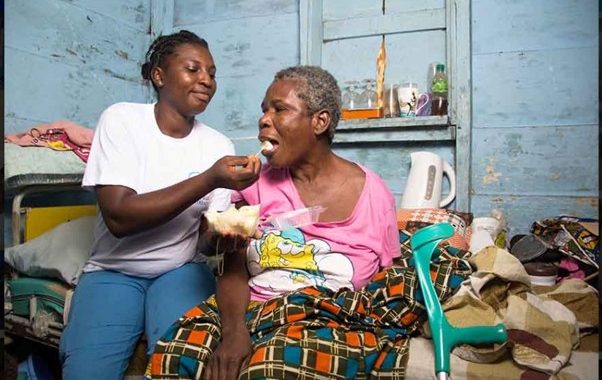
WEE-Ghana’s care framework has emphasised recognition, reduction, redistribution and remuneration as interconnected dimensions of addressing unpaid care. One starting point is to reduce the amount of time and effort required for necessary care and domestic work. WEE-Ghana’s work has drawn attention to practical interventions that can reduce the time women spend on domestic tasks, including reliable water access, improved cooking technologies and accessible, affordable energy supply. Such investments matter because they can release time that women might otherwise spend on unpaid work. The same principle applies to accessible childcare, health services, support for older persons and appropriate services for persons with disabilities. Together, these interventions contribute to women’s economic empowerment by shaping the time and conditions under which women can participate in economic activity
A second requirement is redistribution. Care cannot become more equitable simply by recognising women’s unpaid contribution while leaving them responsible for performing most of the work. Redistribution means considering how responsibility can be shared across households, men and women, communities, employers, markets and the state. It also means asking whether policies intended to support care reach the women who need them most. The experience of maternity and paternity leave has already demonstrated why this matters: protections attached primarily to formal employment can leave many women outside their reach, particularly those working in Ghana’s large informal economy.
A third requirement is investment in care as a sector and source of decent work. Care is already an economy, encompassing formal and informal services and paid and unpaid activities. Yet paid care work can itself be poorly remunerated, reflecting the same social assumptions that have historically feminised and undervalued care. WEE-Ghana’s work has pointed to the potential of developing professional caregiving through existing training institutions. The project’s discussions raised a practical policy question: “could we be intentional as a country in training people to have the expertise and the skills to provide different forms of care?” Such an approach could simultaneously expand the availability of care services and create employment and skills-development opportunities.
From Fragmented Provision to Policy Action
But building a more equitable care economy also requires policy visibility and coordination. Care cuts across multiple areas of policy, from health and social protection to employment, disability, childcare and local services. WEE-Ghana’s policy engagement has therefore drawn attention to the fragmentation of the policy landscape, captured starkly in the observation that the nation lacks a comprehensive care policy. Whether this is addressed through a standalone policy or stronger integration of care across existing policy frameworks, the underlying issue remains important. If responsibility is dispersed across different sectors and institutions, there must be sufficient coordination to ensure that gaps do not arise simply because care responsibilities span multiple institutional mandates.
Visibility also matters for financing. If women continue to absorb care gaps privately, policymakers can underestimate the scale of the problem. This is precisely what makes care deficits difficult to see: women continue to stretch themselves to fill them. Better data on time spent on unpaid care and employment and the economic consequences of care responsibilities can therefore help make those hidden costs visible.
The financing question is equally important. A more equitable care system cannot depend indefinitely on households absorbing the costs themselves. At the same time, public policy must be designed carefully so that support is sustainable, equitable and responsive to different care needs. WEE-Ghana’s policy engagement raises a fundamental question about priorities and resources: “If we do really value care, then we can allocate some resources to give us some basic level of care.” The point is not that public resources are unlimited. It is that what society chooses to value must ultimately be reflected in priorities, resource allocation and implementation.
This is also why the scholarship debate should not be reduced to the question of whether public funds should have been used to support the families of scholarship beneficiaries. That controversy raises legitimate questions about accountability and the proper use of public resources. But viewed through the WEE-Ghana care lens, it also exposes a more fundamental policy dilemma: what happens when women are given opportunities without sufficient attention to the care arrangements that enable them to take those opportunities up? The answer cannot be to assumed that women will simply find a way, because “finding a way” is often precisely how unpaid care burdens remain invisible.
A more equitable care economy would therefore not be one in which government assumes every responsibility. It would be one in which care is recognised, measured, supported, redistributed and appropriately resourced, with different actors taking responsibility for the parts they are best positioned to provide. It would recognise that households matter, but that households cannot indefinitely compensate for gaps in public services, labour-market protections and affordable care provision. It would also recognise that women are not an unlimited reserve of unpaid labour.
Ultimately, women’s economic empowerment is not only about whether women are offered opportunities. It is about whether the conditions surrounding those opportunities allow them to take them up, sustain their participation and benefit from them without carrying disproportionate and invisible costs. Ama’s scholarship dilemma is therefore not an isolated problem. It is a window into a much broader question about how Ghana organises care. If women must continually absorb the gaps in the care system, the question is not whether they are resilient enough. It is whether the system is working well enough. And perhaps that is where the conversation about care needs to move next: from asking women to cope with care, to designing systems that help them do so without absorbing the costs alone.
Ama is a composite character used in this series to illustrate the policy questions raised by the scholarship debate; she does not represent any individual scholarship beneficiary