
From women’s resilience to a more equitable care economy
It is often said that women are natural caregivers. But what if what we call women’s resilience is actually the quiet absorption of a care deficit? Women care for children, tend to sick family members, support older relatives and keep households running, often without these responsibilities being recognised as work or sufficiently reflected in policy and public provision. Because women continue to find ways to make things work, gaps in care provision can remain largely out of sight. The household functions, the child is cared for, the older person is attended to—and the cost of making all of this possible is quietly absorbed, often by women.
This tension came into sharp focus during WEE-Ghana’s August reading session, where the team reflected on care and its implications for women’s economic empowerment. The discussion was anchored in two complementary readings: Rabe’s (2017) examination of care, family policy and social citizenship in South Africa, and UN Women’s (2023) collection of case studies on recognising, reducing and redistributing unpaid care work in West and Central Africa. Together, the readings prompted reflection on how care is organised, who carries its costs and what role public policy can play in creating a more equitable care economy.
When resilience conceals the deficit
A recurring theme throughout the discussion was the extent to which women’s unpaid labour continues to compensate for gaps in care provision. As one team member put it, “We don’t really see the care deficits, and when women continually step in to meet care needs, households and communities continue to function, making it possible for the wider system to appear more adequate than it may actually be.” Yet this resilience has limits. The discussion recognised that women cannot indefinitely absorb unmet care needs without consequences. “You simply can’t stretch care beyond a certain limit,” reflected another team member, “and when women become exhausted, the deficits that their labour had previously concealed become more visible.”
This has direct implications for women’s economic empowerment. The team’s reflection highlighted unpaid care as a significant contributor to women’s time poverty and constraints on their participation in economic activities. A woman may have access to an educational, employment or entrepreneurial opportunity, but her ability to take it up and sustain her participation may depend on who cares for the children, supports an older relative, cares for a sick family member, or performs the daily work of maintaining the household. The question, therefore, is not simply whether women can continue to cope with care. It is what their continued coping is costing them.
Rethinking who is responsible for care
Rabe’s (2017) discussion of social citizenship provided an important lens for this question. If care is understood primarily as a private family responsibility, responsibility for meeting care needs remains largely within households. A social citizenship perspective, however, invites us to consider the roles and responsibilities of the state, family, market and community in ensuring that people can access the care they need.
This prompted the team to consider whether care should be understood more explicitly as a public good and a matter of public responsibility. Such a shift does not necessarily mean that the state must provide every care service directly. Rather, the state could play multiple roles: as a provider of essential services, a trainer of a professional care workforce, a regulator of market-based care and a coordinator of a more coherent care system.
The discussion of professional caregiving illustrated this possibility. Ghana already has an emerging demand for people to care for older persons, children with disabilities and others requiring support. This raises the possibility of investing in training and professionalising care work, potentially creating decent employment while also expanding access to quality care.
The knowledge sharing session amongst the WEE-Ghana team, also challenged the tendency to focus only on those who receive care. Caregivers deserved as much attention as the persons with disabilities they support. Recognising the care recipient without recognising the person providing the care risks leaving a significant part of the care burden invisible.
From isolated interventions to a care system
The UN Women (2023) toolkit brings together case studies and examples from across Africa and beyond—including Cabo Verde, Senegal, Kenya, Ghana, Rwanda, South Africa and Uruguay, as well as examples from Latin America and Asia-Pacific. Two examples were particularly useful to our discussion because they illustrate different ways of responding to unpaid care. The Senegal case study demonstrated that reducing unpaid care does not always mean establishing conventional care services. Investments in water, energy and labour-saving technologies can also reduce the time women spend on everyday domestic tasks. The discussion connected these examples to the time women in parts of Ghana spend collecting water and fuelwood—time that can constrain their participation in economic activity.
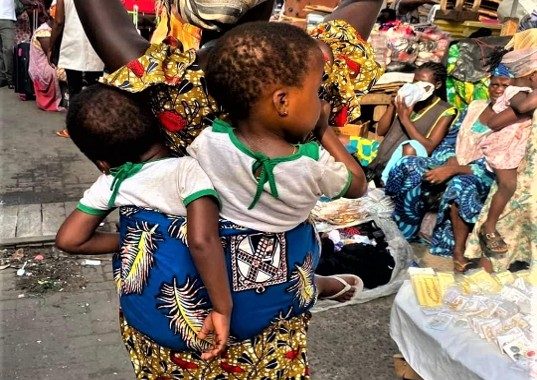
The Makola Market example offered another perspective. Women traders have developed a cooperative childcare arrangement to help them manage their economic activities with their caregiving responsibilities. The example is significant because it demonstrates that communities are not simply waiting for solutions; women are already creating them. The question is how public policy can recognise, strengthen and sustainably support such initiatives without leaving communities—and particularly women—to carry the responsibility alone.
This becomes particularly important because the discussion pointed to a broader gap in Ghana’s policy landscape- the non-existence of a comprehensive care policy. The challenge, therefore, may not be the complete absence of care-related interventions, but the lack of a sufficiently coherent framework that connects them.
The comparative experiences in the UN Women reading illustrate what a more systemic approach can entail: bringing together care services, workforce development, financing, regulation and coordination. For Ghana, the lesson is not necessarily to reproduce another country’s model, but to consider how existing interventions could be better connected within a comprehensive care framework, supported by deliberate financing and stronger institutional coordination.
What does this mean for women’s economic empowerment?
The August deliberation ultimately brought care back to a central concern of WEE-Ghana’s work: women’s ability to participate meaningfully in economic life. If unpaid care contributes significantly to women’s time poverty, then economic empowerment cannot be addressed only through access to jobs, markets, finance, education or enterprise opportunities. It must also consider the unpaid responsibilities that determine whether women have the time and freedom to take advantage of those opportunities.
The discussion therefore invites a shift in perspective. Rather than asking only how women can better manage the care responsibilities they already carry, we might ask how responsibility for care can be organised differently—across households, communities, markets and the state. Perhaps the more uncomfortable truth about resilience is how much women are continually required to stretch themselves to make care arrangements work. But can women continue to stretch in perpetuity? The challenge for policy is therefore not simply to recognise women’s care work, but to reduce the amount of unpaid care they are required to perform and redistribute responsibility for care more equitably across households, communities, markets and the state.
This reflection forms part of WEE-Ghana’s efforts to strengthen knowledge sharing and document key insights emerging from the project’s internal learning and reflection activities.
References
Obeng, I. (2022). A woman from Ghana selling water at Makola, Accra [Photograph].
Wikimedia Commons.
https://commons.wikimedia.org/wiki/File:A_woman_from_Ghana_selling_water.jpg
Rabe, M. (2017). Care, family policy and social citizenship in South Africa. Journal of
Comparative Family Studies, 48(3), 327–338. https://doi.org/10.3138/jcfs.48.3.327
UN Women. (2023). Recognising, reducing and redistributing unpaid care work: Selected
case studies to support reform in West and Central Africa. https://africa.unwomen.org/